The Day Everything Changed
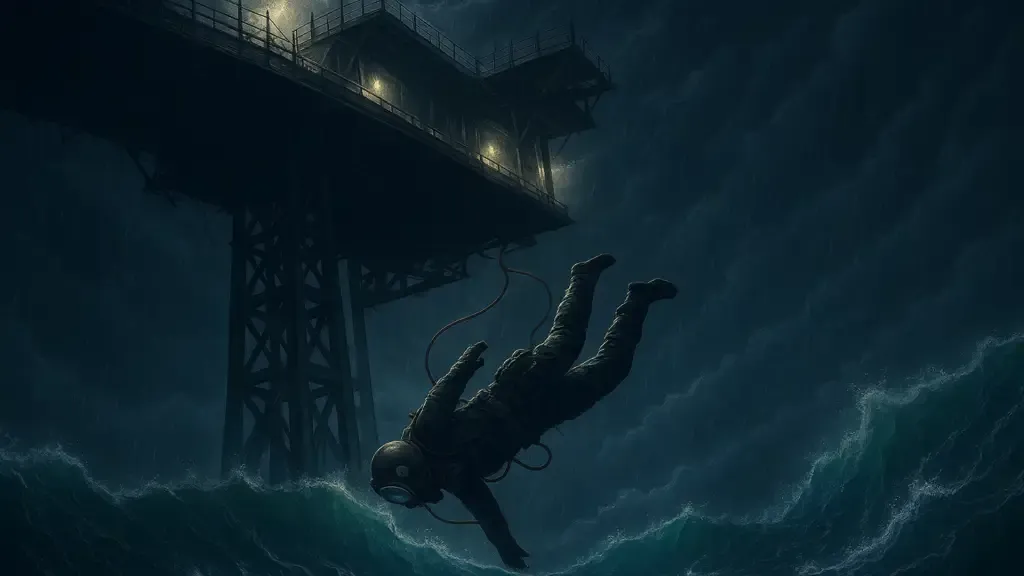
I was 90 feet in the air, dangling from an oil rig in the North Sea, completely unable to move. This is what commercial diving accidents look like in real life—not the training manual version.
Seconds earlier, I’d been sitting in a diving basket, ready for a routine inspection dive. Now I was hanging by my umbilical like a fish on a line, my 140-kilo body (including all the diving gear) swinging in the wind above the water.
This is the story of the diving accident that ended my career underwater—and taught me more about commercial diving safety than any training course ever could.
If you’re considering becoming a commercial diver, this is required reading about commercial diving safety. Because dive schools teach you how to use equipment, but they don’t teach you what happens when everything goes wrong.
What We Were Doing That Day
We were conducting inspection dives on an oil rig called the Janice in the North Sea. The work was straightforward—examining welds on the rig structure for fatigue cracks, the kind of cyclic damage that happens when steel structures move constantly in the water.
The diver before me had been grit blasting, using low-pressure air to blast grit onto the welds to clean off marine growth and paint so we could properly inspect them. Standard procedure.
But that grit? It was about to cause a massive problem.
The Equipment Issue Nobody Caught
When the previous diver came out of the water, his diving helmet was covered in grit—both outside and critically, inside the helmet as well. Grit had gotten into everything, including the valve at the bottom of the helmet.
I put that same helmet on without thinking twice. We got into the diving basket and started descending into the water.
That’s when my helmet started flooding.
The grit had jammed the valve open, and water was pouring into my helmet. Not ideal, but manageable—you can do a wet dive if you need to. I told the supervisor, and we came back to the surface to sort it out.
This delay might have ended my life.
The Fatal Mistake: Out-of-Sequence Operations
Here’s where everything went wrong.
Because we’d come back up out of sequence to fix my helmet, the normal safety procedures got disrupted. Normally, when you get into a diving basket, the crew takes your umbilical—the line that carries your air, communications, and camera feed—and runs a loop (called a catenary) underneath the basket.
This gives you slack. If something snags or goes wrong, you have spare umbilical to work with.
But because I’d come up to fix my helmet, they’d pulled my entire umbilical up through the sheave block (a wheel that centralizes the umbilical as you descend). They never put the catenary back underneath the basket.
To make matters worse, we’d been adding extra equipment to our umbilicals that wasn’t supposed to be there—extra carabiners on D-rings for a safety line we were using because we were breathing nitrox (enriched air). These modifications were out of procedure.
When I got back in the basket after the helmet change, gave the thumbs up, and started descending, my umbilical fed through the sheave block normally at first.
Then the carabiners and D-ring hit the sheave block.
Everything snagged.
The basket kept going. I stopped.
90 Feet in the Air With Nowhere to Go
The first thing I noticed was my tool bag—attached to my umbilical—starting to rise. Instinctively, I reached up to grab it.
That movement was enough.
The 500-kilo diving basket continued downward. I was levered out of the basket, still connected by my umbilical to the sheave block above.
I was now dangling 90 feet above the North Sea, completely helpless.
The crew on deck couldn’t see what was happening—the basket descends below the deck plates, out of sight. The tender holding my umbilical felt it go tight and thought I was snagged on something underwater. He tried to free it, pulling and working the line.
When he finally freed it from the sheave block, he suddenly had the full weight of my body—140 kilos with all the gear—on a relatively thin umbilical.
He couldn’t hold it.
I fell.
The Impact: 45 Miles Per Hour Into Water
From 80 feet up, I hit the water at approximately 45 miles per hour.
In a downward attitude. Head first.
When I impacted, my neck wrenched violently to the side. I heard a massive crack.
And here’s the strange thing about moments like this: people say your life flashes before your eyes. It does, but not the way you’d expect.
I didn’t see my past. I saw my future.
I saw myself in a wheelchair. Someone feeding me. Someone wiping me. Paralyzed from the neck down for the rest of my life because of one moment, one mistake, one oversight in procedure.
That vision felt more real than anything I’d ever experienced.
Paralyzed in the Water
When I came to my senses, I was floating on the surface. The supervisor was shouting in my ear through the comms: “What’s going on? What’s happening?”
I couldn’t answer. I was dazed, disoriented, and most terrifyingly—I couldn’t move my arms or legs.
Complete paralysis.
I was just flopping around on the surface while the crew pulled my umbilical back up. The details after that are hazy—I think the standby diver got into his basket, and they brought me back to the surface.
By the time I reached the dive station, I was starting to get some feeling back in my hands and legs. Small movements. But they couldn’t take any chances—suspected spinal injury means full immobilization.
They strapped me to a spinal board, head locked in place, and called for the Jigsaw helicopter—the emergency medevac helicopter stationed in the North Sea.
The Helicopter Ride I’ll Never Forget
At 4am, the helicopter arrived to take me to Aberdeen Royal Infirmary.
But first, they had to get me up a narrow staircase to reach the helicopter deck. I was strapped immobile to a backboard, unable to move my head or see what was happening.
The guy at the front of the stretcher was massive. The guy at the back was tiny.
As they carried me up the tight stairwell, I tilted at a 45-degree angle. All I could see below me was the North Sea, 300 feet down.
And I thought: “What if they drop me?”
Strapped down, paralyzed, unable to do anything—that might have been scarier than the actual fall.
They didn’t drop me. I made it to the helicopter and then to hospital in Aberdeen.
The Diagnosis: How I Didn’t Break My Neck
The scans came back at Aberdeen Royal Infirmary: I hadn’t broken my neck.
The doctor said I was extraordinarily lucky. He couldn’t explain how my neck hadn’t snapped on impact. What had happened was a spinal shock—my spinal cord had been traumatized by the impact, causing temporary paralysis.
The feeling was coming back gradually. My neck was extremely sore, but I was going to be okay.
Physically, at least.
Going Back to Work: When Your Brain Says No
After a two-week recovery period, the company brought everyone in for a health and safety review. We discussed what went procedurally wrong (everything), and then we went back to work.
I wanted to be the first one back in the water. Get back on the horse. Prove to myself I was fine.
We did a rescue drill first—I was the rescuer, my buddy was playing the casualty. It went perfectly. No issues.
But on the subsequent dives, something was wrong.
The Symptoms Started Small
On one dive, I threw up inside my helmet. I thought I was seasick.
On another, I felt like the air had gone bad. I came back up thinking my gas supply was contaminated.
Dive after dive, something felt off, but I couldn’t pinpoint what.
Then came the dive that changed everything.
The Voice Telling Me to Rip My Helmet Off
I was in a diving basket at depth, acting as “basket bitch”—the diver who stays in the basket and tends the working diver’s umbilical, making sure it doesn’t snag.
Easy job. Low stress. Crystal clear water. Nothing was happening.
And then I heard it: a voice in my head telling me to rip off my helmet.
“You need to get out of this situation NOW. Just rip your helmet off and swim to the surface.”
Complete insanity, obviously—ripping off your helmet underwater means certain death. But the urge was overwhelming.
The rational part of my brain fought back: “You’ve done this thousands of times. You’ve spent thousands of hours underwater. What are you talking about?”
I didn’t tell the supervisor. How do you explain that? So I looked at my dive watch and made a deal with myself: “Five more minutes. I can do five more minutes.”
Then another five minutes.
Then another.
After two and a half hours, the working diver came back to the basket. We surfaced. I went straight to my supervisor and told him everything—all the weird symptoms over the previous dives, and now this overwhelming panic.
His response: “I think you’ve got anxiety.”
PTSD: The Injury Nobody Sees
The company sent me to see a psychologist.
She listened to my story and said: “You have PTSD—post-traumatic stress disorder.”
My response: “I can’t have PTSD. That’s for soldiers coming back from Afghanistan. They’ve been in war. I just fell out of a basket.”
She looked at me calmly: “That’s your frame of reference, but you had a near-death experience. You’re in denial about this, but your brain has responded to trauma.”
She was right.
What PTSD Looked Like for Me
My amygdala—the part of your brain that handles fight-or-flight responses—had learned that “diving = danger.”
Every time I geared up, my body went into panic mode:
- Feeling like something was stuck in my throat when I put on my neck dam
- Nausea before entering the water
- Perceptual narrowing (tunnel vision) underwater
- Overwhelming urge to escape
The rational part of my brain (neocortex) knew I was safe. But my amygdala—the survival instinct—was screaming at me to get out.
And it wasn’t just diving. The anxiety spread:
- Hangover? Convinced I was dying
- Crowded bus? Panic attack
- Flying? Claustrophobia
- Sleep? Impossible—my brain wouldn’t turn off
The SAT Dive That Ended My Career
Despite all this, I tried one more time. I was offered a saturation diving job in Egypt—where you live in a pressurized chamber for a month, getting paid extremely well.
Against my better judgment, my crewmates convinced me to try it.
We did a few dives. They seemed okay. Then came the dive at 300 feet where nothing was happening—crystal clear water, just waiting on the seabed for equipment to come down.
No stress. No danger.
But my buddy Jim started shaking me. The supervisor had been trying to talk to me, but I hadn’t heard a thing.
I’d experienced complete perceptual narrowing—my vision had closed down to looking through two cardboard tubes. My brain was shutting down.
I started breathing rapidly, hyperventilating. The supervisor told Jim: “Get him back to the bell.”
By the time I reached the diving bell, I was breathing so hard I couldn’t even climb my own umbilical. They attached me to the clump weight (emergency recovery system) and pulled me back to the bell, then back to the chamber on the surface.
That was my last commercial dive.
The Pivot: What I Did When I Couldn’t Dive Anymore
I couldn’t put myself in that situation anymore. More importantly, I couldn’t put my dive buddies or the standby diver in danger because of my psychological state.
So I pivoted—multiple times:
1. Dive Supervisor – Managed dive teams from the surface without diving myself 2. Underwater Inspection Controller – Directed inspection work and non-destructive testing 3. Topside Inspector – Moved completely out of the water 4. Client Representative – Now I work for oil companies, overseeing diving contractors to ensure they follow safety procedures
The irony? The accident that ended my diving career gave me the perspective I needed to become excellent at making sure other divers stay safe.
The Critical Safety Lessons
If you’re training to become a commercial diver, here’s what this accident taught me that dive school never will:
1. Procedures Exist for a Reason
Every procedure—no matter how tedious—is written in someone’s blood. The catenary under the basket? That’s not optional. The sequence of operations? Not negotiable.
The moment we started doing things out of sequence, the risk multiplied.
2. Equipment Modifications Kill
We added extra carabiners to our umbilicals because it seemed practical. It wasn’t in procedure, but it made sense for our specific situation.
Those unauthorized carabiners are what snagged in the sheave block.
If it’s not in the procedure, don’t do it.
3. Mental Health Is Safety-Critical
PTSD isn’t weakness. It’s a brain injury—your neural pathways have been rewired by trauma.
If you’ve had a serious accident or near-miss, you need professional help. Not “tough it out.” Not “get back on the horse.”
Get assessed. Get treatment. There’s no shame in stepping back.
4. Communication Saves Lives
I should have spoken up sooner about my symptoms. I was ashamed, worried about being seen as weak or unreliable.
If something feels wrong—even if you can’t articulate what—tell your supervisor. The best supervisors will thank you for it.
What to Do If You’re Facing Similar Issues
If you’ve experienced a diving accident or near-miss and are struggling with anxiety or PTSD:
1. Stop diving immediately – Don’t push through it 2. See a professional – Psychologist or psychiatrist who understands occupational trauma 3. Be honest with your employer – Good companies will support your recovery 4. Explore alternative roles – Supervisor, inspector, technical roles 5. Don’t feel ashamed – This is a medical condition, not a character flaw
The Industry Is Getting Better
When my accident happened, mental health in offshore work was barely acknowledged. You were expected to just deal with it.
Now? The industry is evolving. More companies are implementing mental health support, psychological assessments, and better safety procedures.
But we still have work to do.
Want to Learn More About Getting Into Commercial Diving Safely?
The path to becoming a commercial diver doesn’t have to involve learning through near-death experiences.
Join the Beyond the Surface community where you’ll get:
- Real guidance from experienced divers who’ve been there
- Training school comparisons and honest reviews
- Safety culture discussions
- Mental health resources
- Job hunting strategies
👉 Join the free community here – Learn from people who’ve made the mistakes so you don’t have to.
Final Thoughts
That accident changed everything for me. I lost my diving career, but I gained perspective, empathy, and a mission: making sure the next generation of divers stays safer than we did.
Would I do it all again? Absolutely. The offshore industry has given me an incredible life, amazing experiences, and lifelong friendships.
But I’d do it smarter. I’d ask more questions. I would speak up about mental health sooner and I would never compromise on safety procedures.
Learn from my mistakes. Stay safe out there.
Have questions about commercial diving safety or mental health after accidents? Drop a comment below or join our community to discuss with other divers.