The Question Everyone Asks about a commercial diver salary (But Nobody Answers Honestly)
“How much do commercial divers make?”
I get asked this more than any other question. And I understand why—there are wild numbers everywhere. Stories about six figures, assumptions that all divers are rich, and day rates that sound incredible if you’re earning £25k a year and hating your job. So what is a commercial diver salary?
The problem? Most of the information is outdated, exaggerated, or missing critical context.
Someone tells you the day rate, you multiply it by 365 days, and suddenly you think divers are earning an absolute king’s ransom.
The reality? Some divers do earn a king’s ransom. Others earn a paupers pittance.
So let me give you an honest breakdown with actual numbers—not vague generalities. I’ll tell you:
- Real day rates for different experience levels
- What diving rotations mean for annual income
- Critical deductions nobody mentions
- Whether the money is worth the lifestyle
Scope: This is based on what I know best—the UK and North Sea, with a brief mention of the Middle East and other regions.
By the end, you’ll know what to realistically expect from a commercial divers salary, what your actual take-home is after deductions, and whether this career makes financial sense for you.
Let’s get into it.
The Two Worlds of Commercial Diving
Before we talk commercial diver salary, you need to understand there are two completely different worlds with completely different pay scales:
1. Inshore Diving
- Ports, harbours, fish farms
- Civil engineering projects
- Dams, bridges, pipelines
- You can work most of the year
- Often home some nights (if working near home)
- No rotational perks
2. Offshore Diving
- Oil and gas platforms
- Wind farms
- Diving from vessels in the North Sea
- Rotational work (2-4 weeks on, 2-4 weeks off)
- Seasonal (weather-dependent)
- Higher pay, but inconsistent work
They have completely different pay structures. Let’s break down each one.
Inshore Diving: The Steady but Modest Option
Day Rate: £250-300/day
Full-Time Employee
- Annual salary: ~£50,000
- Benefits: Pension, holiday pay, sick pay
- Steady, predictable income
- You work most of the year
- Can be home nights if working locally
Example: I know a lad who just came out of the army (was a diver there). He’s been offered £50k to work full-time for an inshore diving company. As a newly qualified civils diver, that’s pretty decent starting money for a commercial diver salary.
Freelance Inshore
- Work 7-8 months per year if you hustle
- That’s roughly 140-160 days
- £250-300/day × 150 days = £37,500-45,000 gross
- Before tax, no benefits, no pension
- When you don’t work, you don’t get paid
The Reality
Your £34-40k take-home as an inshore diver is roughly the same as a teacher or nurse.
But:
- You’re away from home for months
- Cold, wet, dangerous work
- Career progression is limited (you can become an inshore supervisor, but you won’t earn much more)
Inshore diving is steady work, but it’s not big money.
Offshore Air Diving: The Seasonal Gamble
Air diving means you leave the vessel, dive, and return to the vessel—as opposed to saturation diving where you live in a chamber.
The Day Rates (North Sea)
Diver (Trainee Level): £660/day
Professional Air Diver: £680/day
What’s the difference?
To qualify as a Professional Air Diver, you need:
- 100 surface supply dives
- 100 hours of bottom time
- At least 70 of those dives from a DP vessel (dynamically positioned vessel—a dive support vessel)
- Minimum of 4 tool competencies (high-pressure water jetting, hydraulic tools, grit blasting, lift bags, dredging equipment, etc.)
The Brutal Reality: You Don’t Work Year-Round
Here’s what nobody tells you:
If you’re really lucky, you get 5 months of work per year.
Why? The North Sea is seasonal. There’s not much work during winter because the weather is too bad.
5 months = roughly 150 days
150 days × £680/day = £102,000 gross
Sounds incredible, right?
But the reality:
- Lots of sitting at home waiting for calls
- Jobs get cancelled at the last minute
- Weather delays mean no work, no pay
- Between contracts, you have no income
- You’re living off the money from your last job
Most air divers don’t get 150 days. If you’re new, expect 80-120 days in your first few years.
Saturation Diving: The Big Money (If You Can Get It)
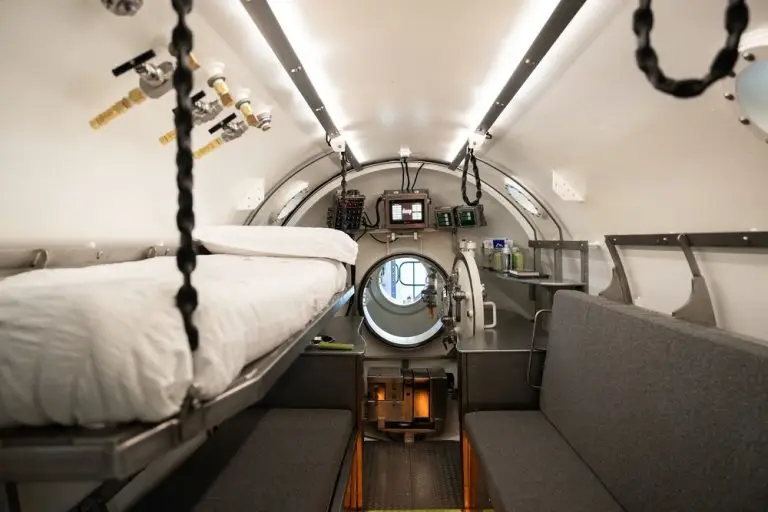
Saturation diving is where you live in a decompression chamber for weeks at a time—usually 28 days minimum. You work deeper, longer, and the money reflects that.
The Day Rates
Mixed Gas Diver (base rate): £665/day
Professional Mixed Gas Diver (base rate): £680/day
Wait, that’s the same as air diving?
Yes. The base rate is similar.
But here’s where it gets interesting:
The SAT Bonus: £50 Per Hour While in Saturation
While you’re locked in that steel tube breathing helium, you get £50/hour, 24 hours a day.
£50 × 24 hours = £1,200/day
Total daily rate in SAT: £680 + £1,200 = £1,880/day
Let’s round that to £2,000/day for simplicity.
The Annual Reality
If you get regular SAT work (which is difficult), you’re looking at:
4 full SATs per year = 4 rotations × 28 days = 112 days
112 days × £2,000/day = £224,000 gross
But getting regular SAT work is extremely difficult. It’s not unattainable, but it’s not easy.
To Qualify as a Professional Bell Diver:
- 100 surface supply dives
- 100 closed bell lockouts (leaving the bell to dive)
- 400 lockout hours (time spent out of the bell)
- 70 dives and 70 hours offshore from a DP vessel
- Minimum of 4 tool competencies
The Middle East: Different Rules, Different Money
The Middle East is a completely different market.
Low-End (Avoid These)
- $150/day – I’ve seen jobs advertised at this rate
- Expat divers won’t work for this
- Unfortunately, some local divers do
Standard Expat Rates
- $250-350/day – Standard experienced diver
- $400/day – Experienced diver with inspection tickets and diver medic certifications
- $500-600/day – Dive supervisor
Note: I’m not sure about Gulf Of Mexico rates as I haven’t worked there. If anyone has current numbers, send them my way and I’ll update this.
Australia has similar commercial diver salary pay structures to the UK.
The Math Everyone Gets Wrong
Here’s what people do when you tell them you earn £680/day:
£680 × 365 days = £248,200/year
And they think you’re rich.
That’s not how it works. Here’s the reality:
Annual Income: What You’ll ACTUALLY Make
Let me break down realistic annual income for each tier of commercial diver salary:
Inshore (Full-Time Employee)
- £50,000/year (gross)
- Benefits: Pension, holiday pay, sick pay
- Steady work, predictable income
- Take-home after tax: ~£38,000
Inshore (Freelance)
- 140-160 days of work if you hustle
- £250-300/day
- £35,000-40,000 gross
- Take-home after tax: ~£28,000-32,000
- No benefits, no pension
Offshore Air Diving
- 150 days of work (if you’re lucky—seasonal)
- £665-680/day
- £100,000 gross
- Lots of sitting at home waiting for calls
- Take-home after tax and expenses: ~£66,000
Saturation Diving
- 4 full SATs per year (if you can get regular work)
- 112 days × £2,000/day
- £224,000 gross
- Take-home after tax and expenses: ~£127,000
But getting regular SAT work is difficult.
The Deductions Nobody Mentions
Let’s do the real math on a SAT diver earning £224k gross:
Gross Income: £224,000
Tax (Self-Employed)
- Personal allowance: £12,570 (tax-free)
- Taxable: £211,430
- Basic rate (20% on £37,700): £7,540
- Higher rate (40% on £125,140): £50,056
- Additional rate (45% on £48,590): £21,866
- Income tax: £79,462
National Insurance
- 9% on £37,700: £3,393
- 2% on remaining £173,730: £3,475
- NI: £6,868
Other Expenses
- Accountant: £1,500
- Travel costs (flights, hotels): £4,000
- Medical certificates: £800
- Training/renewals: £800
- Equipment: £1,000
- Total expenses: £8,100
Total Deductions: £94,430
NET INCOME: £129,570
Still excellent money—but not £224k.
The Lifestyle Tax: What You’re Really Trading
Beyond the financial numbers, there’s a cost nobody calculates:
Time Away
- 112 days in SAT = nearly 4 months locked in a steel tube
- Miss birthdays, anniversaries, weekends, weddings
- Relationships suffer
- Your wife deals with everything alone
- Your kids grow up without you
Physical Toll
- Living in a chamber for weeks
- Breathing helium (your voice goes squeaky)
- Physical toll on your body
The Emergency Problem
If you’re injured in SAT, it takes days to decompress you.
A deep SAT might take 5 days to decompress. There’s no way to speed it up—they have to release the pressure extremely slowly.
It’s actually quicker to bring people back from space than from the depths of the ocean.
If you chop your leg off, crush your arm, need hospital—it still takes 5 days to get you out.
If one of your children has an accident, if someone in your family dies, if they need you at their bedside—you still can’t leave for 5 days.
That can be extremely hard.
Career Comparison: Is Diving Worth It?
Let’s be honest about the money relative to other careers:
Inshore Diver
- £34k-38k take-home
- Same as a teacher or nurse
- But you’re away 6 months, cold, wet, dangerous work
- Career progression limited
Offshore Air Diver
- £66k take-home
- Good money, no question
- But you miss half your life
- Hard on relationships
SAT Diver
- £127k take-home
- Genuinely excellent money
- But locked in a tube for weeks
- Can’t leave in emergencies
- Physical and mental toll
Shore-Based Comparisons
Project Manager (onshore): £60-80k salary
- Home every night
- Pension, sick pay, holiday pay
- Career ladder, promotions
- Normal life
Software Developer: £40-80k
- Work from home
- Similar money to air diving
- No physical risk
Senior Tradesperson: £40-60k
- Run your own business
- Similar to air diving
- Work year-round onshore
The diving premium exists, but it’s not as dramatic as you’d think when you factor in lifestyle sacrifices.
The Golden Handcuffs
Here’s what I’ve seen happen to so many guys:
You get used to the money. Lifestyle inflation kicks in.
You’ve got:
- A nice house
- A nice car
- Expensive holidays
- Private schools for the kids
And then you can’t leave.
Normal jobs pay £30-40k. You need £100k to maintain your lifestyle.
You feel trapped by your own success.
I’ve seen guys in their 40s who hate diving. Marriages struggling. But they can’t afford to quit.
They need that £100k, and they’re not going to get it outside diving very easily.
The Real Question: Is the Money Worth What You’re Giving Up?
The honest answer? It depends on you.
The Money IS Good If:
- You have no commitments and you’re young
- You love adventure
- You thrive on this lifestyle
- Being away doesn’t bother you
The Money ISN’T Enough If:
- You want a normal family life
- You want routine and stability
- Your body can’t handle the work
- You’re only doing it for the money
My advice: Don’t chase a day rate. Chase the right fit for your life.
A £45k job you enjoy beats a £100k job you hate.
Trust me—I’ve seen both.
What You Need to Consider
Beyond the salary, think about:
- Relationship status – Can your relationship handle months apart?
- Health and fitness – Can your body handle the physical demands?
- Long-term goals – Where do you see yourself in 10-20 years?
- What you want from life – Money vs. time, adventure vs. stability
Being a diver can be absolutely amazing. But you need to weigh the pros and cons carefully.
Want Real Guidance on Commercial Diving Careers?
No bullshit. No inflated promises. Just honest advice from people who’ve lived this life.
Join the Beyond the Surface community and get:
- Real salary breakdowns by experience level
- Tax strategies (employed vs self-employed)
- Training cost analysis and ROI
- Job hunting strategies that actually work
- Support from people who understand the reality
👉 Join the free community here – Get the truth before you spend £10k on dive school.
Final Thoughts
Commercial diving can be financially rewarding. A SAT diver earning £127k net is doing extremely well by any measure.
But:
- The path takes 5-10 years
- The first few years are financially rough
- The lifestyle trade-offs are significant
- Jobs get cancelled, weather delays happen, work is inconsistent
Go into this with your eyes open.
Understand the real numbers. Budget conservatively. Have a financial cushion for lean months.
And remember: if you do it just for the money, you’ll burn out.
Do it because you love being underwater, crave adventure, and want to be part of a tight-knit community doing work most people can’t comprehend.
The money is the bonus. The lifestyle is the reward (or the sacrifice, depending on your perspective).
Got questions about commercial diving salaries? Want to discuss career progression? Join the conversation in our community.